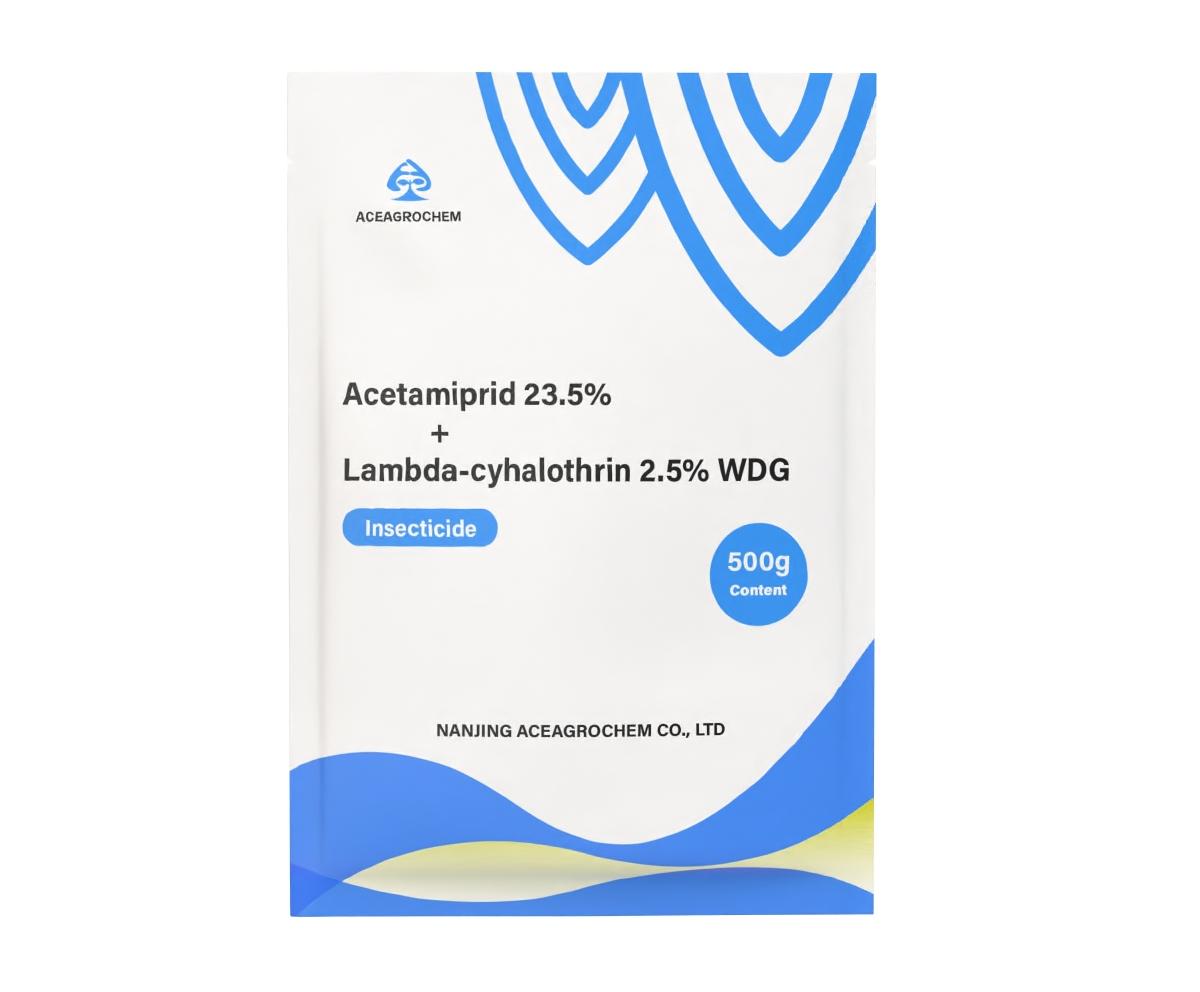
Acetamiprid 23.5% + Lambda-cyhalothrin 2.5% WDG
Classification:
Insecticide
Formulation:
Acetamiprid 23.5% + Lambda-cyhalothrin 2.5% WDG (Water-Dispersible Granule)
CAS NO:
Acetamiprid: 135410-20-7;
Lambda-cyhalothrin: 91465-08-6
USAGE:
A broad-spectrum insecticide for controlling a wide range of pests in various
crops, such as aphids, thrips, leafhoppers, and lepidopteran larvae in fruits,
vegetables, cereals, and cotton.
Pack size:
100g, 250g, 500g/bag, or as required
Direction for Use
| Crop | Target Pests | Dosage (23.5% Acetamiprid + 2.5% Lambda-cyhalothrin WDG) | Application Timing | Remarks |
|---|---|---|---|---|
| Fruits | Aphids | 80-120 g/ha | Early pest stage | 1) REI: 12 hrs 2) Max 2 applications/season |
| Vegetables | Thrips | 60-100 g/ha | When pests first appear | Add wetting agent for better control |
| Cereals | Leafhoppers | 100-150 g/ha | Active growth stage of pests | PHI: 21 days |
| Cotton | Lepidopteran larvae | 120-180 g/ha | Before larvae reach the peak | Use high-pressure sprayer for better penetration |
Product Details
Mode of Action:
-Acetamiprid acts on the insect's nervous system by binding to nicotinic
acetylcholine receptors, causing nerve impulse disruption.
-Lambda-cyhalothrin affects the insect's sodium channels, leading to paralysis
and death.
-The combination has both contact and stomach-poisoning effects.
Benefits:
-Synergistic effect between acetamiprid and lambda-cyhalothrin, enhancing pest
control efficacy.
-Broad-spectrum pest control, reducing the need for multiple Pesticide.
-Rainfast within 2 hours after application.
-Relatively low residue on crops.
Precautions:
-PPE: Chemical-resistant gloves, respirator, goggles
-Do not apply during flowering to avoid harming pollinators
-Tank mix with caution, avoid mixing with alkaline Pesticide
-Storage: Keep in a cool, dry place at 0°C to 35°C
Environmental Hazards:
-Toxic to bees and other pollinators
-Do not apply near beehives or during bee-active hours
-Moderate toxicity to aquatic organisms, do not contaminate water bodies
-Low toxicity to birds and mammals