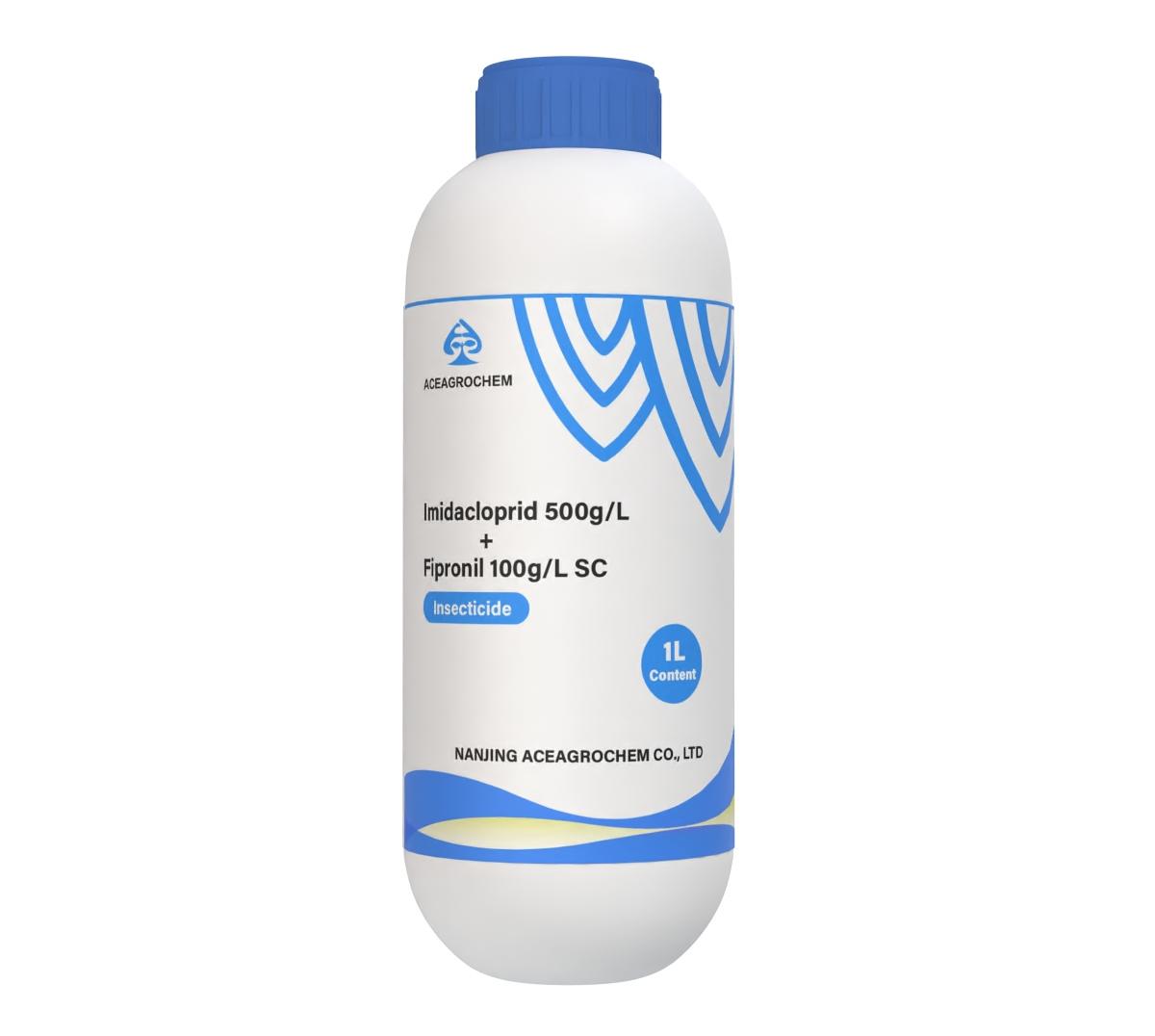
Imidacloprid 500g/L + Fipronil 100g/L SC
Classification:
Insecticide
Formulation:
Imidacloprid 500g/L + Fipronil 100g/L SC (Suspension Concentrate)
CAS NO:
Imidacloprid: 138261-41-3;
Fipronil: 120068-37-3
USAGE:
A broad-spectrum insecticide for controlling a wide range of pests on various
crops such as rice, wheat, vegetables, and fruits. It is effective against
sucking and chewing insects including aphids, thrips, whiteflies, termites, and
beetles.
Pack size:
500mL, 1L, 5L, 20L/drum, or as required
Direction for Use
| Crop | Target Pests | Dosage (Imidacloprid 500g/L + Fipronil 100g/L SC) | Application Timing | Remarks |
|---|---|---|---|---|
| Rice | Stem borers, leafhoppers | 300-500 mL/ha | At the early stage of pest infestation | 1) REI: 72 hrs 2) Do not apply during the flowering stage |
| Wheat | Aphids, armyworms | 250-400 mL/ha | When pests reach the economic threshold | 1) Add a spreader for better coverage 2) Avoid application in high-temperature weather |
| Vegetables | Whiteflies, thrips | 200-300 mL/ha | Early growth stage of vegetables | 1) Check for possible phytotoxicity on sensitive varieties 2) Do not harvest within 10 days after application |
| Fruits | Fruit borers, scale insects | 350-550 mL/ha | Before the peak of pest activity | 1) Dilute properly to avoid residue on fruits 2) Do not spray on windy days |
Product Details
Mode of Action:
-Imidacloprid acts on the nicotinic acetylcholine receptors of insects, disrupting
the normal conduction of the insect nervous system.
-Fipronil targets the gamma-aminobutyric acid (GABA)-gated chloride channels,
interfering with the central nervous system of insects.
-The combination has both contact and systemic action, providing comprehensive pest
control.
Benefits:
-Broad-spectrum pest control on different crops.
-Long-lasting efficacy due to the combined action of two active ingredients.
-Low application rate, reducing the cost of pest control.
-Good compatibility with other Pesticide in most cases.
Precautions:
-PPE: Wear chemical-resistant gloves, protective clothing, and goggles.
-Do not apply near water bodies to avoid contamination.
-Avoid contact with skin and eyes. In case of contact, rinse immediately with
plenty of water.
-Storage: Keep in a cool, dry place at a temperature between 0°C and 35°C.
Environmental Hazards:
-Toxic to bees and beneficial insects. Do not apply during the flowering period of
crops.
-Moderately toxic to aquatic organisms. Avoid runoff into water sources.
-Low toxicity to birds and mammals under normal use conditions.