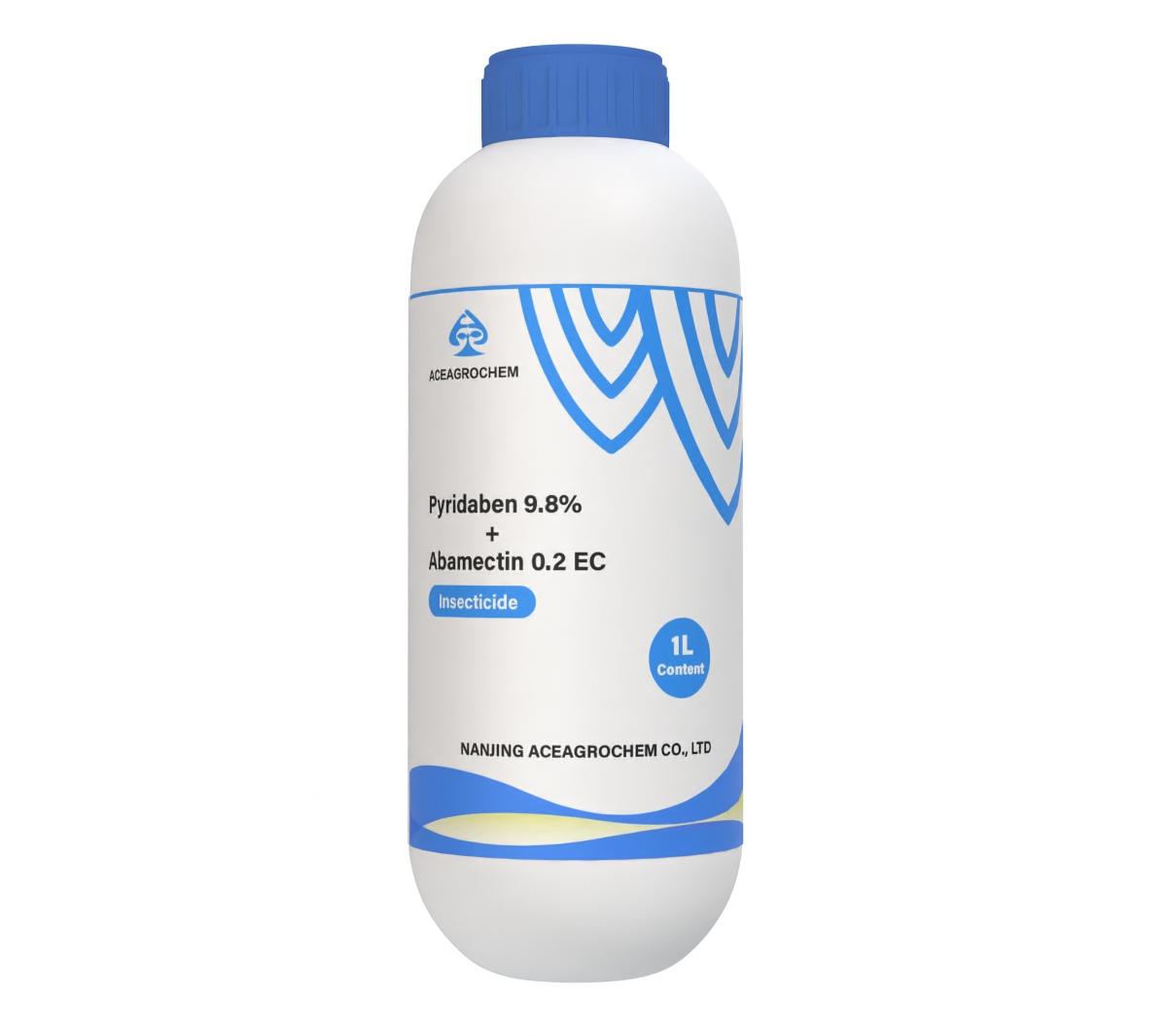
Pyridaben 9.8% + Abamectin 0.2 EC
Classification:
Insecticide and acaricide
Formulation:
Pyridaben 9.8% + Abamectin 0.2% EC (Emulsifiable Concentrate)
CAS NO:
Pyridaben: 96489-71-3;
Abamectin: 71751-41-2
USAGE:
This product is a compound insecticide and acaricide, which can be used to
control various mites and insects on crops such as fruit trees, vegetables, and
tea. It has good control effects on Tetranychus cinnabarinus, Panonychus citri,
and other mites, as well as some Lepidoptera pests.
Pack size:
500mL, 1L, 5L, 20L/drum, or as required
Direction for Use
| Crop | Target Pests | Dosage (Pyridaben 9.8% + Abamectin 0.2% EC) | Application Timing | Remarks |
|---|---|---|---|---|
| Fruit trees | Spider mites | 1000-1500 times dilution | Early stage of mite infestation | 1) REI: 14 days 2) Do not spray during blooming period |
| Vegetables | Thrips, Spider mites | 800-1200 times dilution | When pests first appear | 1) PHI: 7 days 2) Spray evenly on both sides of leaves |
| Tea | Tea red spider mite | 1200-1800 times dilution | Before the peak of mite population | Do not spray before tea-picking |
Product Details
Mode of Action:
-Pyridaben: It inhibits mitochondrial electron transport at the ubiquinone
reduction step, causing energy metabolism disorder in pests.
-Abamectin: It binds to glutamate-gated chloride channels in nerve and muscle
cells of pests, increasing the permeability of chloride ions and causing paralysis
and death of pests.
-The compound formulation has a synergistic effect, expanding the pest-control
spectrum and enhancing the control effect.
Benefits:
-Broad-spectrum pest control, effective against multiple pests.
-High efficiency, can quickly reduce the pest population.
-Long-lasting effect, providing long-term protection for crops.
Precautions:
-PPE: Wear chemical-resistant gloves, goggles, and protective clothing.
-Do not apply when winds exceed 15 km/h to prevent drift.
-Do not mix with alkaline Pesticide.
-Storage: Store in a cool, dry, and well-ventilated place at 0°C to 35°C.
Environmental Hazards:
-Toxic to fish and other aquatic organisms, do not contaminate water sources such
as rivers, lakes, and ponds.
-Low toxicity to birds and mammals under normal use conditions.
-Degradable in soil, but long-term large-scale use may have an impact on soil
microorganisms.